Raxis Strike
Point-in-Time Penetration Testing
Run a focused assessment for an annual testing requirement, a launch, or a specific security question. Use Raxis One to follow the engagement through reporting and retesting.
Real people finding the path. You see the proof.
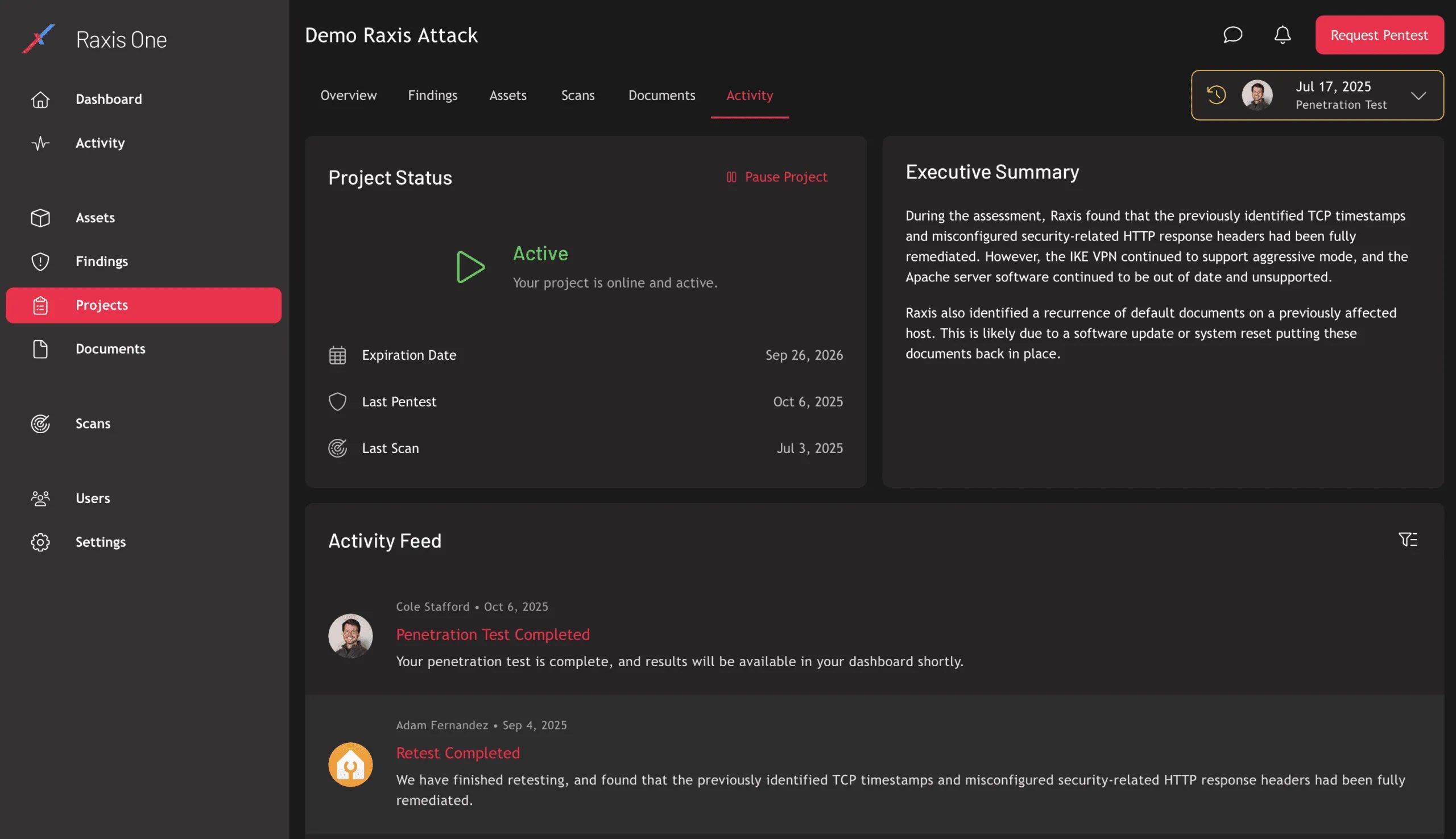
Follow your penetration test from the agreed scope to the verified fix. Raxis One brings live findings, conversations with your testers, remediation progress, and reporting into one place.
Nothing replaces skill.
Review findings as your tester logs them, including severity, affected assets, and proof-of-concept evidence. Start triaging while the engagement is still in progress.
Message the engineers running your test. Clarify the impact, discuss a remediation approach, and coordinate a retest with the people who know the finding.
Track assets, project status, findings, and remediation across engagements. Keep the context in one console as your team moves from discovery to resolution.
Day 1
Started recon on the records API. Resource IDs increment in the open: /records/1001, 1002, 1003. Filing a Low for predictable identifiers. More testing tomorrow.
Mar 2, 2026, 6:44 PM
Testing EndedMar 2, 2026, 1:12 PM
Testing StartedDay 2
Confirmed the IDs increment across the collection, and on related objects. Still a Low on its own. Checking whether anything rate-limits a sweep.
Mar 3, 2026, 5:19 PM
Testing EndedMar 3, 2026, 8:51 AM
Testing StartedDay 3
No throttle. A full sweep of the ID space in about twelve minutes. Forty thousand IDs. Second Low: missing rate limiting.
Mar 4, 2026, 6:02 PM
Testing EndedMar 4, 2026, 9:04 AM
Testing StartedDay 4
Any valid session token reads any object. Ownership is never checked. Third Low: insecure direct object reference. Three Lows, one shape. Tomorrow we chain them.
Mar 5, 2026, 7:11 PM
Testing EndedMar 5, 2026, 8:47 AM
Testing StartedDay 5
Chained predictable IDs, no rate limit, and IDOR. One session, every tenant. Filing as Critical. CWE-200. Exposure of sensitive information.
Mar 6, 2026, 4:38 PM
Testing EndedMar 6, 2026, 9:15 AM
Testing StartedDay 6
Proof is in the report. GET /records/{id} with a normal user session returns other tenants' names, emails, and account numbers. Drafted the fix: bind IDs to the authenticated tenant, rate-limit enumeration, deny by default.
Mar 9, 2026, 5:55 PM
Testing EndedMar 9, 2026, 8:33 AM
Testing StartedDay 7
Tightened the write-up. Steps to reproduce, impact, and a fix an engineer can ship Monday. No further findings on this path.
Mar 10, 2026, 3:41 PM
Testing EndedMar 10, 2026, 9:20 AM
Testing StartedDay 8
Testing complete on the records API. Critical finding delivered with the path, the proof, and the fix. Ready for your patch window.
Mar 11, 2026, 12:16 PM
Testing EndedMar 11, 2026, 8:58 AM
Testing StartedDay 9
Retest. Enumeration is blocked. Cross-tenant reads return 404. Finding closed.
Mar 12, 2026, 11:42 AM
Retest EndedMar 12, 2026, 10:05 AM
Retest StartedDay 10
Debrief with management. Walked the chain from three Lows to a Critical, the proof, and the verified fix.
Mar 13, 2026, 2:48 PM
Debrief EndedMar 13, 2026, 2:00 PM
Debrief StartedKeep remediation in the tools your engineers already use. Send findings from Raxis One into Jira with the project, issue type, naming, and fields your team expects.
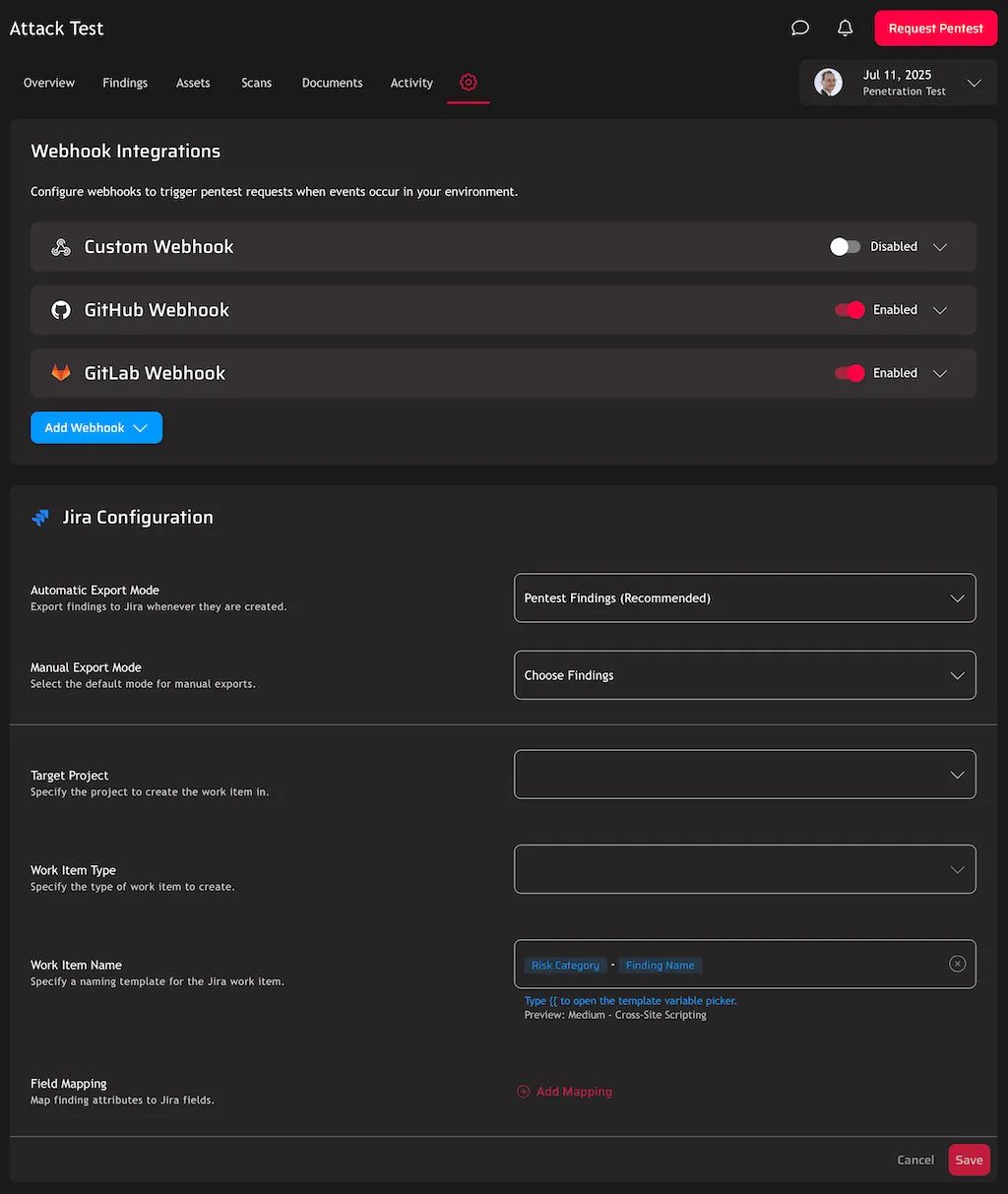
Enable automatic export when a finding is logged, or push selected findings manually. GitHub and GitLab integrations also let your team receive findings as issues where they track development work.
Select the target Jira project and work item type, define a naming template, and map finding attributes to your fields. Carry severity, affected assets, and remediation guidance into the work item.
Route notifications to Slack or Microsoft Teams. Use custom webhooks to connect other tools, from a CI/CD pipeline to your security operations stack.
Use the same platform to plan the test, follow the evidence, and show what changed.
Keep web applications, APIs, internal networks, and cloud assets together. Review testing status, scan results, and findings against the assets in your engagements, including when several projects are running at once.
Initiate testing requests from your development workflow through GitHub, GitLab, or custom webhooks. Connect platforms such as Jenkins, AWS CodePipeline, and CircleCI, then bring findings back into your team’s workflow.
Generate PDF reports with executive summaries, technical findings, proof-of-concept evidence, severity ratings, MITRE ATT&CK mapping, and prioritized remediation guidance. Share the appropriate detail with leadership, auditors, and the engineers doing the fixes.
Request retesting after your team applies a fix. Review the result in Raxis One and keep a documented record of what was verified, alongside the original evidence and remediation history.
Point-in-Time Penetration Testing
Run a focused assessment for an annual testing requirement, a launch, or a specific security question. Use Raxis One to follow the engagement through reporting and retesting.
Penetration Testing as a Service
Build ongoing testing into the way your team works. Request assessments, follow findings, and retest fixes throughout the year as your applications and infrastructure change.
Raxis One is the secure, centralized platform that powers every Raxis penetration testing engagement. Whether you're running a targeted assessment with Raxis Strike or continuous testing with Raxis Attack, everything flows through Raxis One, from scoping and scheduling to live findings, engineer collaboration, and final reporting. Instead of waiting on emailed reports and chasing down status updates, your team gets a single console with real-time visibility into your security posture from day one through remediation.
Raxis Strike is our traditional penetration testing service, a comprehensive, point-in-time assessment ideal for annual compliance testing or one-time security evaluations. All findings, reports, and retesting workflows are managed through Raxis One. Raxis Attack is our Penetration Testing as a Service (PTaaS) offering that provides unlimited, continuous penetration testing throughout the year. It includes real-time vulnerability monitoring, ongoing expert assessments, and full DevSecOps integration through Raxis One, making it the right choice for organizations that need continuous security validation rather than point-in-time snapshots.
As your Raxis engineers discover vulnerabilities during an engagement, findings are pushed directly to your Raxis One dashboard in real time, no waiting for the final report. Each finding includes a severity rating, proof-of-concept evidence, affected assets, and prioritized remediation guidance. Your team can begin triaging and remediating critical issues while testing is still in progress, dramatically compressing the time between discovery and resolution.
Raxis One includes direct messaging with the engineers actively running your engagement, no ticket queues, no account managers acting as middlemen. You can ask questions about specific findings, discuss exploitability, request clarification on remediation steps, and coordinate retesting all within the platform. This direct line to your pentest team is one of the key advantages of working with Raxis over larger firms where communication is filtered through layers of project management.
Raxis One is built to fit into the tools and workflows your team already uses. Native GitHub and GitLab integrations push findings straight into your repositories as actionable issues, Jira automatically creates and tracks remediation tickets from pentest findings, and Slack and Microsoft Teams deliver instant vulnerability notifications to the channels your team monitors. Custom webhook support connects Raxis One to anything else in your security stack, including your SIEM, ticketing system, or internal tooling, so if your team uses a tool not listed here, you can still build the connection you need.
Yes. Raxis One supports CI/CD-triggered penetration tests through native integrations with GitHub and GitLab, as well as custom webhook support for any other platform, Jenkins, AWS CodePipeline, CircleCI, and more. Your pipeline sends a request to Raxis One to initiate a test, and findings flow back into your workflow automatically. This makes security testing a built-in part of your development process rather than a separate, manual step.
Raxis One generates professional, audit-ready PDF penetration testing reports on demand directly from your console. Every report includes an executive summary for C-suite and board audiences, detailed technical findings with proof-of-concept evidence and severity ratings, prioritized remediation guidance, and MITRE ATT&CK framework mapping. Reports can be shared instantly with auditors, compliance teams, or your development staff, and remain accessible in your console throughout the engagement and beyond.
Raxis One gives you a centralized view of every asset in scope across your engagements, web applications, APIs, internal networks, cloud environments, and more. You can view scan results and live vulnerability data directly in your dashboard, track testing status per asset, and monitor remediation progress over time. This eliminates the siloed spreadsheets and back-and-forth emails that typically make asset tracking a pain point during penetration testing engagements.
Yes, retesting is included with both Raxis Strike and Raxis Attack. Once your team has remediated a finding, you can request retesting directly through Raxis One. The same engineers who identified the vulnerability will re-evaluate it to confirm it has been properly resolved and check for any new risks that may have emerged during the remediation process. All retest results are tracked within the platform, giving you a clear, documented record of your improving security posture.
Raxis One can push instant vulnerability notifications to your Slack channels or Microsoft Teams workspace as findings are discovered during an engagement. This means your security team, developers, or on-call staff can be alerted to critical issues in real time, without having to log into the platform to check for updates. Notifications can be routed to the channels most relevant to your team's workflow, keeping the right people informed without creating noise for everyone else.
Yes. Raxis One is built to handle multiple concurrent engagements from a single console. You can track the status, findings, and remediation progress of each project independently while maintaining a unified view of your overall security posture. This is particularly valuable for organizations running Raxis Attack, where continuous testing means there may always be an active engagement in progress alongside new assessments being scoped and scheduled.
Raxis One reports are designed to satisfy audit and compliance requirements across a wide range of frameworks and standards, including PCI DSS, HIPAA, SOC 2, ISO 27001, NIST 800-171 and CMMC, SOX, and GLBA. Each report includes attestation letters and MITRE ATT&CK mapping to demonstrate your security due diligence to auditors, regulators, and customers.
Raxis One access is included with every Raxis engagement, there's no separate license or setup fee. When you start a Raxis Strike or Raxis Attack engagement, your team receives secure access to the platform where your project will be managed from scoping through final report delivery. To see Raxis One in action before committing to an engagement, you can request a demo and one of our team members will walk you through the platform and answer any questions.
Yes. Raxis One is purpose-built to handle sensitive security data. All communication between your team and the platform is encrypted, access is role-based, and your findings and reports are only visible to authorized users within your organization. We never use your data for AI training or share it with third parties. Given that Raxis One contains detailed vulnerability information about your systems, we take platform security as seriously as we take the engagements we run inside it.